
Table of Contents
- Introduction
- How Twisting Poses Strengthen the Core
- Top Twisting Yoga Poses for Core Strength
- Tips for Practicing Twisting Yoga Poses Safely
- Conclusion
Twisting Yoga Poses involves rotating the spine while maintaining a stable base. Twisting poses also known as spinal twists or parivrtta. These poses increase flexibility and tones the core muscles. The "core" is a complex collection of muscles including the rectus abdominis (the "six-pack), the internal and external obliques (in charge of side bending and twisting), the transverse abdominis (a deep, stabilising corset-like muscle), and the lower back's erector spine muscles. In twisting poses, these muscles stabilise the spine, initiate the rotation, and protect the spine.
How Twisting Poses Strengthen the Core
Twisting poses are a highly effective way to strengthen the core:
- Targets Oblique Activation: Particularly targets the oblique muscles which is necessary for torso rotation. The twists help these muscles. This boosts strength and endurance.
- Transverse Abdominis Engagement (Inner Core Muscle): The deep transverse abdominis muscle contracts when you twist to produce a corset-like effect around your waist. It gives the necessary stability for the spine and supports internal organs.
- Isometric Contraction: Many basic muscles contract isometrically, that is, without movement, to preserve the twist and stabilise the spine.
- Spinal Stability and Mobility: Strong, twisting poses promotes spinal mobility by lubricating the spinal discs and releasing tension in the back muscles. A strong, but flexible spine defines a good core.
- Improves Sense of Movement: Twisting helps your body become more conscious in space, thereby enhancing core control and stability even more.
[shortcode id="6a38b8359d1a3c57081c4768"
name="twisting yoga poses" layout="Carousel"]
Top Twisting Yoga Poses for Core Strength
Here are five top twisting yoga poses that are excellent for strengthening the core, along with steps for practicing them:
1. Supta Matsyendrasana (Reclined Twist Pose)

Steps:
- Lie on your back with your knees bent and feet flat on the floor.
- Place a bolster perpendicular to your body, aligning the center with your hips.
- Extend your arms out to the sides, palms facing down.
- Gently twist your torso to the right, letting your right knee fall over your left leg.
- Rest your left hand on your right knee and your right hand on the floor behind you.
- Hold for several breaths, then repeat on the other side.
2. Parivritta Parshvakonasana (Revolved Side Angle Pose)

Steps:
- Place the yoga chair on your mat so that it is stable.
- Position the yoga block within reach of where your hand will be during the pose.
- Stand in Tadasana (Mountain Pose) facing the chair.
- Step your feet wide apart about 3-4 feet, turning your right foot out in 90 degrees and your left foot slightly in.
- Bend your right knee to a 90-degree angle and place it on the seat of the chair, ensuring that your knee is directly above your ankle. Your thigh should be parallel to the floor.
- Keep your left leg straight and strong, pressing the outer edge of your left foot into the mat.
- Inhale and extend your arms out to the sides at shoulder height, parallel to the floor, with your palms facing down.
- Exhale and hinge at your hips, bringing your left hand to rest on the brick kept on the floor for extra height and right hand above the head fingers pointing out.
- Your hand should be directly under your shoulder.
- Lengthen your spine with an inhale and with an exhale, twist your torso to the right.
- Bring your right hand to your right hip or extend it up towards the ceiling.
- Turn your head to look up at your top hand or keep your gaze forward or down if it's more comfortable for your neck.
- Keep your core engaged to support the twist and protect your lower back.
- Hold the pose for several breaths, maintaining the twist and the length in your spine.
- To come out of the pose, inhale and return to an upright position.
- Straighten your front leg and bring your feet back together into Tadasana.
- Repeat the pose on the other side.
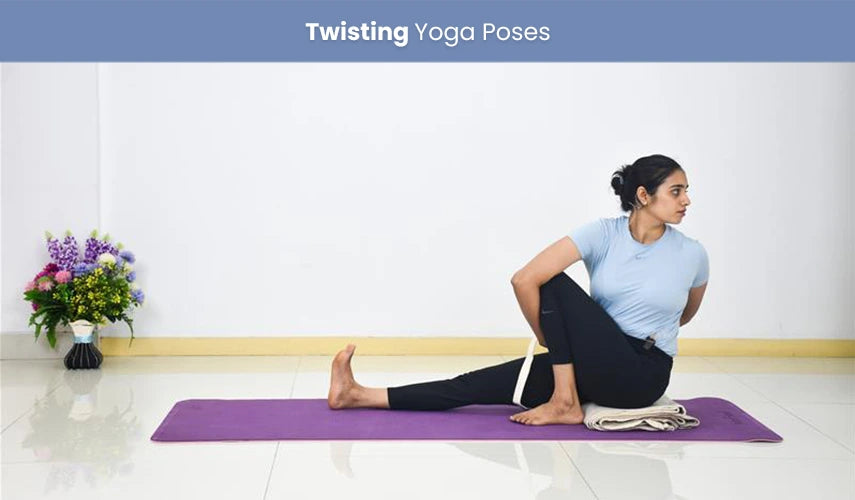
3. Marichyasana III (Sage Twist III Pose)

Steps:
- Fold the blanket and place it on your mat to sit on. Have the yoga belt within reach.
- Sit on the blanket in Dandasana (Staff Pose) with your legs extended straight in front of you. Ensure you are sitting firmly on your sitting bones.
- Bend your right knee and place the right foot flat on the floor close to your right sitting bone. The left leg remains extended on the floor.
- Wrap the belt around your right shin and hold the belt with both hands. This will help you maintain the twist and keep your torso upright.
- Inhale to lengthen the spine, creating space between each vertebra.
- Exhale and twist your torso to the right, using the belt to help deepen the twist. Keep your left leg active and pressing into the floor.
- Draw your right shoulder back to deepen the twist without forcing it.
- Turn your head gently to look over your right shoulder, aligning your neck with the rest of your spine.
- Keep your face and jaw relaxed.
- Breathe deeply and evenly throughout the pose. Use each inhale to lengthen the spine and each exhale to deepen the twist.
- Stay in the pose for 5-10 deep breaths, focusing on maintaining the twist with each exhale and lengthening the spine with each inhale.
- Slowly untwist your torso on an exhale.
- Follow the same steps on the other side, reversing the leg positions and twisting to the left.
- Slowly untwist your torso and release the legs by extending forward.
[shortcode id="6a38b8e39d1a3c57081c478f"
name="twisting yoga poses - 1" layout="Carousel"]
4. Ardha Matsyendrasana (Half Lord of the Fishes Pose)

Steps:
- Sit with both legs extended straight out in front of you.
- Place a bolster under the hips for support.
- Bend your right knee and place your left foot on the floor outside your right knee.
- Twist your torso to the left in such a way that your left hand takes support from the bolster.
- Bring your right elbow to the outside of your left knee
- Keep your spine long and gaze over your left shoulder.
- Repeat the same on other side.
5. Parivrtta Trikonasana (Revolved Triangle Pose)

Steps:
- Place the chair on your mat, ensuring it is stable.
- Fold the blanket and place it on the back stand of the chair for cushioning.
- Stand in Tadasana (Mountain Pose) facing the side of the chair.
- Step your feet about 3 to 4 feet apart, with your right foot facing forward and your left foot turned out about 45 degrees.
- Align your heels so they are in line with each other.
- Square your hips to face forward. Draw your left hip forward and your right hip back.
- Inhale and extend your arms out to the sides at shoulder height, parallel to the floor, with your palms facing down.
- Exhale and hinge forward from your hips over your right leg.
- Place your left hand on the down leg of the chair and rest your head on the blanket placed on the upper handle of the chair.
- Keep your gaze forward with the comfortable position for your neck.
- Lengthen your spine with an inhale, and with an exhale, twist your torso to the right.
- Keep your hips squared and your spine long.
- If needed, adjust the blanket or the position of your hand on the chair to maintain proper alignment.
- Maintain steady and even breathing throughout the pose.
- To come out of the pose, inhale and return to an upright position.
- Bring your feet back together and return to Tadasana.
- Repeat the pose on the other side.
Tips for Practicing Twisting Yoga Poses Safely
- Warm-Up Thoroughly: Never twist with cold muscles into extreme angles. To ready your body, start with light spinal motions, cat-cow, and sun salutations.
- Keep Spine Straight: Always keep your spine straight while inhaling before beginning the twist on the exhale. This releases space between your vertebrae and stops compressive action.
- Engage Your Core: Engaging your abdominal muscles. The rotation should start from the navel area instead of forcing the twist from your lower back. Keep your hips stable.
- Listen to Your Body: Never force a twist. Back off right once if you have any acute pain. Your body will open more with regular, little exercise over time.
- Breathe Deeply and Smoothly: Your breath is vital. You have gone too far if your breath starts to feel shallow or strained. To help you to twist and keep your muscles relaxed, keep a consistent, even breathing.
- Use Props: To discover greater comfort, stability, and length in the posture, don't hesitate to utilise props like blocks under your hands or a folded blanket beneath your sitting bones.
- Consult Doctor: Consult your doctor or a skilled yoga therapist before doing twists if you are pregnant, have significant back ailments, or have lately had stomach surgery.
- Follow Up with a Counter Posture: Practice a counter posture like Childs pose (Balasana) after a deep twist. This helps in relaxing the spine.
Conclusion
Twisting Yoga Poses for core provide excellent benefits for core strength, spinal health, and general energy. These positions help to improve posture, flexibility, and stability in daily activities by strengthening the stomach and back muscles. Regular twisting mixed with mindful attention to alignment and breath will not only strengthen your core but also allow you to create a better understanding with your body.


