
Table of Contents
- Introduction
- Benefits of Having a Home Yoga Studio
- Choosing the Right Space at Home
- Essential Yoga Props on a Budget
- Tips for Setting Home Yoga Studio
- Conclusion
Many people make New Year's resolutions to take better care of themselves, and for many, that means finally starting a regular yoga practice. Joining a studio gives you a sense of community, but nothing beats the comfort and ease of a home yoga studio, especially for beginners.
Unless you want it to be, it's not a fancy room with windows that go all the way to the floor and incense smoke. A home yoga studio is any space, big or small, where you regularly do yoga, meditation, or mindfulness. It could be a corner of your bedroom, a clear area in your living room, or a quiet spot on your porch.
In today's busy world full of screens, having a dedicated space tells your brain that it's time to change gears. It changes your practice from something you do occasionally to something you do every day. Seeing your mat unrolled and your props nearby makes it easier to stay consistent and removes obstacles. It is your own private space, always ready for you.
Benefits of Having a Home Yoga Studio
Setting up a dedicated space has real benefits that help you keep up your practice over time:
- Ultimate Convenience: You don't have to worry about traffic or the weather, and you don't have to rush to get to class. Your practice is just a few steps away. You can practice for five minutes or ninety minutes, depending on your schedule. Your studio is open all day, every day, from early morning to late at night.
- Affordable: Even though you must invest in simple props up front, you will save a lot of money in the long run compared to paying for a monthly studio membership.
- Privacy: If you are new to yoga, you might feel shy about trying new poses. You can wobble, fall, try an inversion, and make changes at home without worrying about what other people will think.
- Personalized Environment: You get to choose the music (or silence), the scents, the temperature, and the lighting. This customized setting makes you as comfortable and focused as possible.
Choosing the Right Space at Home
You don't need a whole room; you just need enough space to stretch your arms and legs all the way out.
- Find the Perfect Spot: Find a space that is at least the size of your yoga mat, with some extra room around the edges for adjustments.
- Light and Air: A spot near a window that gets natural light is best because sunlight can make you feel better and give you more energy. Make sure it has good airflow.
- Minimal Distraction: This is the most important thing. Don't put your space right next to a loud TV, the main path through the kitchen, or your desk. To focus and meditate, you need to be quiet.
- Flooring: If you can, pick a place that isn't carpeted. It can be hard to balance on carpet. If you must use carpet, make sure your mat is extra thick or has a good grip.
Essential Yoga Props on a Budget
Don't fear expensive gear. You only need yourself and a comfortable surface, but a few simple props can make the practice much better.
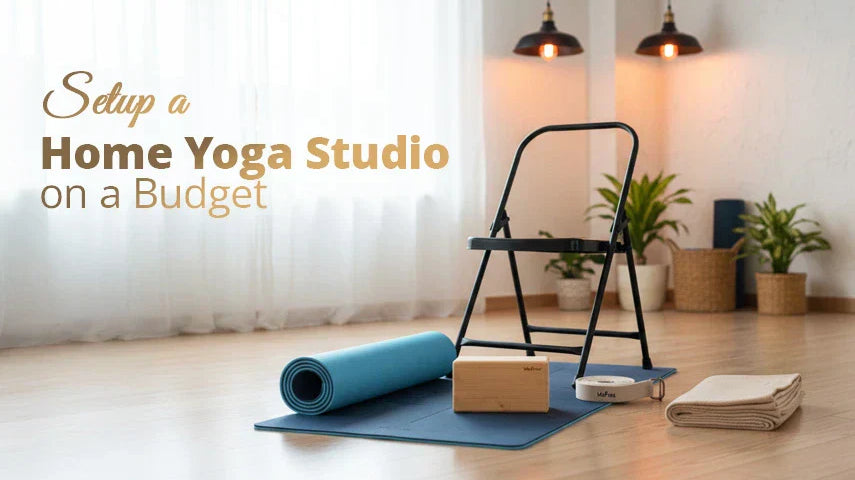
- Yoga Mat (Towel/Rug): Using mat for practicing yoga provides grip, cushioning, and a dedicated, non-slip space for your practice.
- Yoga Belt: Using belt for yoga extends your reach in forward folds and bending poses to achieve proper alignment and deep stretching.
- Blocks: Using yoga blocks bring the floor closer to you, offer stable support under hands or hips, and modify challenging postures for safety.
- Blanket: Adding blanket in your yoga routine offers gentle padding for kneeling, provides comfortable elevation for seated meditation, and keeps you warm during Savasana (Corpse Pose).
Tips for Setting Home Yoga Studio
Once you have picked a place and gotten your basic tools, use these tips to make the space good for practice:
- Clean Up the Area: A messy mind comes from a messy space. Don't put laundry, papers, or anything else that isn't yoga in the yoga area. Simplicity helps you stay focused.
- Use Scent: Light a candle with a calming scent or use a diffuser with essential oils like lavender (to relax) or peppermint (to focus).
- Hang a Focal Point: Put a piece of art, a plant, or even a picture of a peaceful scene on the wall to use as your Drishti (focal point) while you do balance poses.
- Set Up a Practice Basket: Put all your props (blocks, strap, blanket) in a basket or container that is easy to reach near your mat. This makes it easy to set up and takes away any excuses.
- Use Proper Lighting: Use natural light when you can. If you practice at night, use soft, indirect light instead of harsh overhead lights that can be distracting.
Conclusion
One of the best things you can do to stick to a healthy routine this New Year is to set up a yoga studio at home. It doesn't need a big investment or a lot of work; it just needs to be done with purpose.
By giving your mat, a special place and getting the right tools to help you, you are making a promise to yourself. You are making a place where you can stop worrying about being flexible and just focus on the journey of becoming flexible—one breath, one pose, in your own personal sanctuary.