
Table of Contents
- Introduction
- Why Choose Yoga for Better Sleep?
- Best Yoga Poses for Sleep
- Breathing and Meditation Practice for Good Sleep
- Conclusion
Deep sleep is a medicine to an exhausted body and of good health. There are various signs of bad sleep like waking up throughout the night or just waking up feeling completely tired after trying to sleep for hours. When your sleep patterns are unhealthy, you may end up with serious problems including chronic weariness, being more irritable, having trouble paying attention and concentrating, having a weaker immune system, and being more likely to get sick. All these have led people to seek alternate methods along the natural-holistic line for maintaining healthy sleep hygiene. Contrarily, yoga for sleep is the ancient holistic way of creating a comfortable ambiance for sleep.
Why Choose Yoga for Better Sleep?
Yoga targets the root causes of sleeplessness by calming the nervous system and reducing stress. Here's why it stands out as an excellent choice for enhancing your sleep quality:
- Calms the Nervous System: The movement, breath, and relaxation processes involved in the practice of yoga naturally bring about physiological changes within the body, such as decreasing the heart rate and blood pressure and quieting the mind. In that way, the body is then told that it is safe to relax and let go into sleep.
- Reduces Anxiety and Stress: The yoga practice certainly involves meditation and mindful slowing down of breath to enable the mind to watch passing thoughts rather than engage with them as if it were a mental tape. This mental detachment from the thought chatter will stop ruminations and allow an inner feeling of peace to help with sleep.
- Alleviates Discomfort: Yoga allows for gentle stretching and strengthening of the body as you solicit your body to release tension from a muscle while increasing flexibility.
- Setting Mindfulness and Body Awareness: Yoga calls you to be present in your body and sensations. That mindfulness extends, among other things, to noticing when your body is tired or when your mind is racing.
Best Yoga Poses for Sleep
Incorporating a short sequence of calming yoga poses into your evening routine can significantly prepare your body and mind for restorative sleep. Hold each pose for 1-5 minutes, focusing on deep, conscious breathing.
1. Child's Pose (Balasana):
 Steps:
- Start on your hands and knees in a tabletop position.
- Place a block or bolster under your chest or abdomen for extra support.
- Gently lower your hips toward your heels, stretching your arms forward on the mat.
- Rest your forehead on the bolster or on a block, allowing the bolster or block to support your torso.
- Place a blanket under your hips to support the pose.
- Relax into the pose, breathing deeply to release tension in the back and hips.
2. Reclined Twist Pose (Supta Matsyendrasana):

Steps:
- Lie on your back with your knees bent and feet flat on the floor.
- Place a bolster perpendicular to your body, aligning the centre with your hips.
- Extend your arms out to the sides, palms facing down.
- Gently twist your torso to the right, letting your right knee fall over your left leg.
- Rest your right hand on your right knee and your left hand on the floor behind you.
- Hold for several breaths, then repeat on the other side.
3. Legs-Up-The-Wall Pose (Viparita Karani):
 Steps:
- Sit next to a wall and lie on your back, swinging your legs up against the wall.
- Bring your hips close to the wall, placing the bolster below the back, keeping legs straight and feet pointing up.
- Rest your arms by your sides, palms facing up.
- Close your eyes, relax, and breathe deeply.
- Stay in the pose for 5-15 minutes.
4. Reclined Bound Angle Pose (Supta Baddha Konasana):

Steps:
- Start by lying on your back with your knees bent and feet together, allowing your knees to fall outward.
- Place a bolster under your spine for support and roll a blanket and place it under your head for added comfort.
- Relax your arms by your sides, palms facing upward.
- Close your eyes, focus on your breath, and gently allow your hips to open, deepening the stretch without straining.
5. Corpse Pose (Savasana):

Steps:
- Lie flat on your back with your legs extended and arms by your sides.
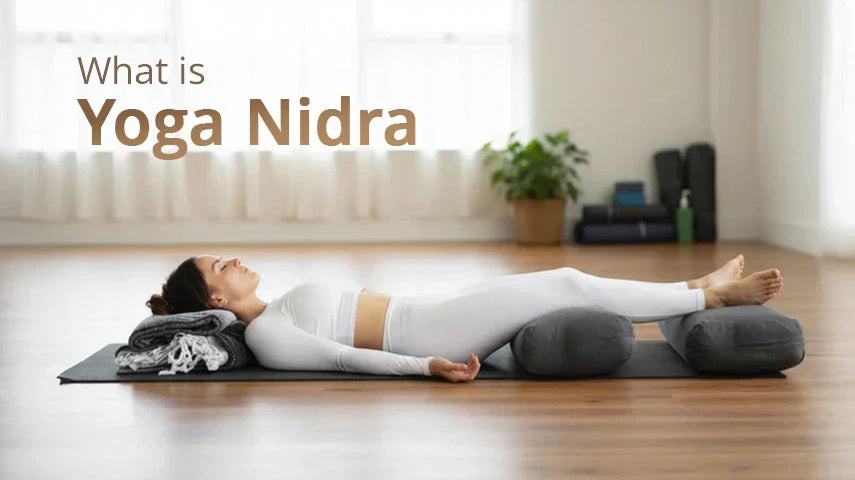
- Place a bolster under your knees or a blanket under your head for extra comfort.
- Allow your arms to relax, palms facing upward.
- Close your eyes, focus on your breath, and allow your body to fully relax.
Breathing and Meditation Practice for Good Sleep
Beyond physical poses, the power of breathwork (Pranayama) and meditation is paramount for inducing sleep. These practices directly influence your nervous system, guiding it from a state of alertness to one of deep relaxation.
1. Alternate Nostril Breathing (Nadi Shodhana Pranayama):
Nadi Shodhana is a calming and balancing technique that involves alternating the breath between the left and right nostrils. This practice helps to balance the body's energy and reduce stress. When using a pranayama pillow or bolster during this practice, it is helpful to sit comfortably in a cross-legged position or on your knees. The pranayama pillow can also be placed beneath the hips to elevate the body, ensuring a straighter spine and a more relaxed seated position. This allows for easier breath flow and deeper focus.
Steps:
- Sit comfortably with a straight spine.
- Place your left hand on your left knee, palm up.
- Bring your right hand to your face: rest your index and middle fingers between your eyebrows. Your thumb will close the right nostril, and your ring finger will close the left.
- Close your right nostril with your thumb and inhale slowly through your left nostril.
- Close your left nostril with your ring finger, release your thumb from the right nostril, and exhale slowly through the right nostril.
- Inhale through the right nostril.
- Close your right nostril with your thumb, release your ring finger from the left nostril, and exhale slowly through the left nostril.
- This completes one round. Continue for 5-10 minutes, maintaining a smooth, even breath.
2. 4-7-8 Breathing Technique:
Developed by Dr. Andrew Weil, this is a simple yet powerful technique, helping you fall asleep faster.
Steps:
- Lie in bed in a comfortable position.
- Place the tip of your tongue against the ridge of tissue just behind your upper front teeth and keep it there through the entire exercise.
- Exhale completely through your mouth, making a gentle "whoosh" sound.
- Close your mouth and inhale quietly through your nose to a mental count of four.
- Hold your breath for a count of seven.
- Exhale completely through your mouth, making a "whoosh" sound, to a count of eight.
- This is one breath. Inhale again and repeat the cycle three more times for a total of four breaths.
3. Body Scan Meditation:
This mindfulness practice involves systematically bringing awareness to different parts of the body, noticing sensations without judgment. It helps to release physical tension and quiet the mind.
Steps:
- Lie comfortably in Savasana (Corpse Pose).
- Close your eyes and take a few deep, conscious breaths.
- Bring your awareness to your feet. Notice any sensations – warmth, coolness, tingling, pressure. Just observe without trying to change anything.
- Slowly move your attention up your body, to your ankles, calves, knees, thighs, hips, abdomen, lower back, upper back, chest, hands, arms, shoulders, neck, face, and finally the top of your head.
- As you move your awareness, mentally soften and release any tension you find in that area.
- If your mind wanders, gently bring it back to the body part you are focusing on.
- Continue for 10-20 minutes, or until you drift off to sleep.
Conclusion
In a world spending so much energy to keep us "on," yet somehow remaining dedicated on sleep is an act of self-care. The pursuit of sleep may feel elusive a lot of times, yet yoga for sleep is a great age-old, natural, and empowering alternative to take back your peaceful nights. Gentle poses, calming breathwork, and mindful meditation are the things you want to apply to your evening routine to mellow out your nervous system, hush down the incessant mind talking, and unwind from the day.