
Table of Contents
- Introduction
- How to do Gomukhasana Without Props
- How to Do Gomukhasana with Props
- Benefits of Practicing Gomukhasana
- Common Mistakes & How to Fix Them
- Who Should Avoid Gomukhasana?
- Conclusion
Gomukhasana, also known as Cow Face Pose, is a traditional seated yoga posture with great stretch and strong alignment advantages. The term comes from the Sanskrit words "go" (cow) and "mukha" (face). If we draw the symmetrical form of the pose, the legs are crossed like the jaw and the arms are like the ears. This posture is firmly anchoring and often included in Hatha, Iyengar, and restorative yoga to open the hips, shoulders, and chest. It is also a great accompaniment to both physical and mental activities since it invites silence, patience, and concentration. Gomukhasana provides layers of advantages whether done with or without props; nevertheless, it also depends on mindfulness and good alignment to prevent tension. Let's know more safe and efficient ways to perform it.
How to do Gomukhasana Without Props
Gomukhasana can be practiced without any props once you have built enough flexibility in the hips, shoulders, and spine. Here's your step-by-step guide:

Steps:
- Sit with your back straight on a yoga mat (Dandasana).
- Keep both the feet together.
- Bend the right knee.
- Bring your right foot to the outside of your left hip, so that your right knee is stacked on top of your left knee.
- Keep yourself grounded to the floor through your sitting bones.
- As you inhale, lengthen your spine and stretch your arms out to the sides, palms facing forward.
- Internally rotate your right shoulder so that your palm faces the wall behind you. Sweep the right arm behind your back, walking your hand up between your shoulder blades, palm facing outwards.
- Stretch the left arm up, fingertips pointing towards the ceiling, the palm of your hand still facing forward. Bend the elbow and reach down for the right fingertips, hooking the fingers together if they reach.
- Stay in this position for a few breaths.
- To come out of the pose, release the arms, uncross the legs and repeat on the other side.
How to Do Gomukhasana with Props
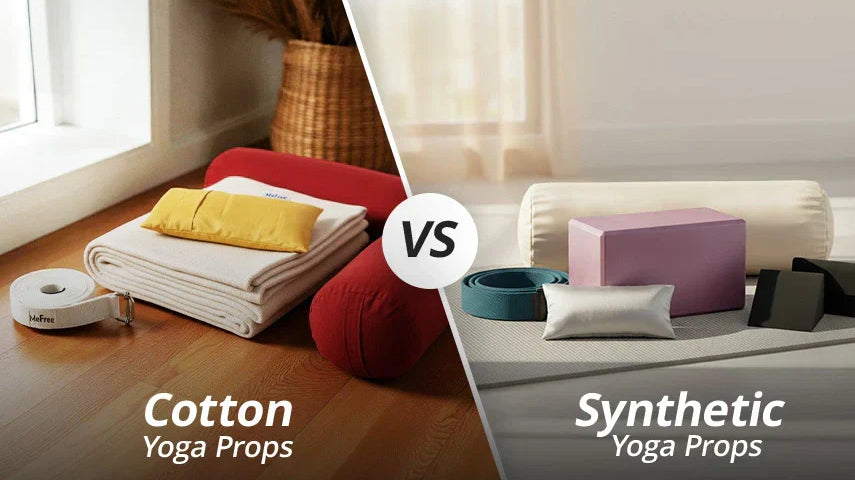
Props can make Gomukhasana more accessible, especially for beginners or those with tight hips and shoulders. Here are three common variations using props:
1. Gomukhasana with a Yoga Belt and Yoga Blanket or Yoga Block

Steps:
- Begin by sitting on a yoga blanket or a yoga block in a cross-legged position with your knees stacked on top of each other.
- Bring your right arm behind your back, holding the yoga belt, bending the elbow and reaching your hand up towards the shoulder blades.
- Extend your left arm overhead and stretch the yoga belt, bend the elbow to reach down towards the right hand.
- Stretch the yoga belt with your right hand and left hand.
- Keep your chest open and spine tall, breathing deeply into the stretch.
- Hold for several breaths, then switch sides.
2. Tadasana Gomukhasana with Yoga Belt

Steps:
- Stand on your yoga mat like Tadasana.
- Bring your right arm behind your back, holding the yoga belt, bending the elbow and reaching your hand up towards the shoulder blades.
- Extend your left arm overhead and stretch the yoga belt, bend the elbow to reach down towards the right hand.
- Stretch the yoga belt with your right hand and left hand.
- Keep your chest open and spine tall, breathing deeply into the stretch.
- Hold for several breaths, then switch sides.
Benefits of Practicing Gomukhasana
Practicing Gomukhasana regularly can offer a wide range of physical and mental benefits:
Physical Benefits:
- Opens tight shoulders and chest, improving posture.
- Stretches the hips, glutes, and thighs, releasing deep-seated tension.
- Relieves sciatica and piriformis-related discomfort.
- Increases joint mobility, especially in the shoulders and hips.
- Improves lung capacity by expanding the rib cage through proper arm positioning.
Mental Benefits:
- Encourages mindfulness and stillness.
- Stimulates Swadhisthana (sacral) and Anahata (heart) chakras.
- Reduces stress and anxiety through focused breathing.
Common Mistakes & How to Fix Them
Even experienced practitioners can make subtle alignment mistakes. Here are a few common mistakes that you should watch out for:
| Mistake | Correction |
| Knees are misaligned or spread apart. | Sit on a block/blanket to help stack the knees vertically. |
| Back is rounding or collapsing. | Lengthen the spine and sit up tall. |
| Forcing the hands to clasp behind the back. | Use a yoga belt to avoid shoulder strain. |
| Shoulders scrunching toward the ears. | Relax the shoulders and broaden the collarbone |
| Uneven hips or tipping on one side. | Use a prop like block or blanket to support and level your pelvis. |
Who Should Avoid Gomukhasana?
Gomukhasana is a very beneficial pose, but it may not be suitable for everyone. You should avoid or modify the pose if you have:
- Severe knee injuries or arthritis.
- Shoulder impingements or recent rotator cuff injuries.
- Sciatic pain aggravated by compression.
- Tight hips or hamstrings that limit mobility (use props).
- Recent surgery involving the spine, hips, or shoulders.
If unsure, always consult with a qualified yoga teacher or healthcare provider.
Conclusion
Together with developing focus and balance, the strong, multifarious Gomukhasana provides a deep stretch to the hips, shoulders, and spine. It may be modified to fit a great spectrum of body types and experience levels whether done in its whole or with props. Reaping its advantages mostly depends on patience. Respect the limits of your body; utilize props when necessary; and pay more attention to conscious breathing than perfection. Your flexibility and alignment will grow with time; Gomukhasana will become a basic grounding and energizing tool for your yoga practice.