
Table of Contents
- Introduction
- Benefits of Inversion Yoga Poses
- Inversion Yoga Poses to Try
- Things to Keep in Mind Before Trying Inversions
- Who Should Avoid Inversion Yoga Poses?
- Conclusion
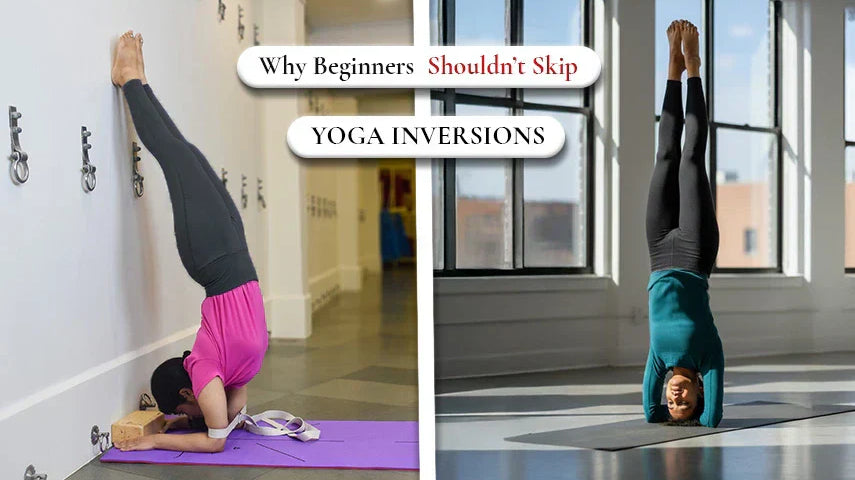
Let's talk about inversion yoga poses and flip your world in the best possible way! If you have witnessed someone in a yoga class gracefully balancing on their hands or on their head, you could easily assume inversions are only for advanced yogis. But that would not be accurate! There are some great inversion postures to explore for both beginners and advanced practitioners. We want to be clear that inversions don't need to be extreme; even mild inversions can provide some pretty inspiring benefits!
Benefits of Inversion Yoga Poses
Inversion yoga poses offer a whole host of fantastic benefits, both physical and mental:
- Increases Circulation: Being in an upside-down position can help blood flow to your brain, increasing circulation to the whole body.
- Reduces Stress and Anxiety: Flipping upside down is an amazing way to reduce stress and anxiety symptoms for the nervous system. You are seeing everything from a new height and perspective, literally! Being upside down will help you feel grounded in your body.
- Builds Core and Upper Body Strength: Many inversions yoga poses take a significant amount of core and upper body strength to hold you in the pose. Consistent practice will strengthen all those muscles in the long run.
- Enhances your Balance and Proprioception: Being upside down can force you to engage your sense of balance in new ways and ultimately build your spatial awareness and stability.
- Increases Energy and Focus: Because extra blood is flowing to your brain, feeling a rush of energy, vigour and focus after a period of being upside down can be a great surprise.
- Enhances Lymphatic Flow: Getting upside down also can help move lymphatic fluid through your lymphatic system which is always a good thing and good for overall health.
- Increases Confidence: To try and hold an inversion, regardless of how "serious" the pose is can be an amazing confidence booster and empowering.
Inversion Yoga Poses to Try
Here are some awesome inversion yoga asanas, with steps for getting into them. Remember to take your time and listen to your body!
1. Adho Mukha Svanasana (Downward-Facing Dog Pose)
 Steps:
- Begin in a tabletop position with hands under shoulders and knees under hips.
- Take two yoga blocks, keep your palms on it for support, tuck your toes, and lift your hips toward the ceiling.
- Try to keep your legs straight while keeping a slight bend in the knees if needed.
- Place yoga block below your head for the support.
- Gently press your heels toward the mat without forcing them.
- Keep your arms straight, shoulders away from ears, and engage your core.
- Stay for a few breaths, keeping a steady and even inhale-exhale.
- Lower your knees back to the mat to exit the pose.
Benefits: This is a classic yoga pose and a fantastic gentle inversion. It also helps to calm the brain and relieve stress, while boosting circulation to the head and revitalizing the body. This pose is excellent for building overall strength and flexibility.
2. Viparita Karani (Legs-Up-The-Wall Pose)
 Steps:
- Sit next to a wall and lie on your back, swinging your legs up against the wall.
- Bring your hips close to the wall, placing the bolster below the back, keeping legs straight and feet pointing up.
- Rest your arms by your sides or stretch them over the head, palms facing up.
- Close your eyes, relax, and breathe deeply.
- Stay in the pose for 5-15 minutes.
Benefits: Super restorative and incredibly relaxing, this pose is perfect for beginners and anyone looking for a gentle inversion.
3. Sarvangasana (Shoulder Stand Pose)
 Steps:
- Take a yoga chair, bolster & blanket for support.
- Fold a Mat and place it on the seat of the yoga chair and above that place a folded blanket for extra support to the lower back.
- Sit on the edge of the chair and lower yourself down onto the mat, ensuring your head is close to the bolster.
- Lie down on your back with holding the chair seat and your shoulders supported by the Bolster.
- Engage your core muscles and use your abdominal strength to lift your legs up toward the ceiling.
- With your legs lifted, slide your torso closer to the chair so that your hips are supported by the chair.
- The bolster should rest just below your shoulders and chair providing support for your lower back.
- Straighten your legs upward toward the ceiling, keeping them active and engaged.
- Use your hands to support your lower back and adjust the position as necessary for comfort.
- Keep your neck long and relaxed, with your gaze directed toward your chest.
- Hold the pose for few seconds, breathing deeply and evenly.
- Gently release the pose by lowering your legs and carefully lifting yourself upward to sit on the chair. Gradually come out of the chair.
Benefits: Often called the "Queen of Asanas," Shoulder Stand Pose is a powerful inversion. This pose is highly beneficial for improving blood circulation and calming the nervous system to reduce stress and anxiety. It also strengthens the core, neck, and shoulders.
4. Pincha Mayurasana (Feathered Peacock Pose)
 Steps:
- Come onto your hands and knees on your mat.
- Tie a loop of yoga belt in your both the arms to keep the arms & elbows in line with the shoulders.
- Place your forearms on the mat with the yoga block positioned between your hands.
- Your forearms should be parallel and shoulder-width apart, supported by the belt.
- Press your forearms firmly into the mat and grip the block with your hands.
- Spread your fingers wide and press down through your fingertips.
- Engage your shoulders by drawing them away from your ears and pressing your shoulder blades towards your spine.
- Engage your core muscles to support your spine and maintain stability.
- Tuck your toes under and lift your hips up, coming into Dolphin Pose (Ardha Pincha Mayurasana).
- Walk your feet closer to your elbows to bring your hips over your shoulders.
- Shift your weight onto your forearms and lift one leg up towards the ceiling.
- Engage your core and use the strength of your shoulders and arms to help lift the other leg off the ground.
- If needed, use a small hop to help lift both legs up.
- Once both legs are up, engage your legs and bring them together or keep them slightly apart (hip-width).
- Keep your toes pointed and legs active, creating a long line from your feet to your forearms.
- Ensure your shoulders stay directly over your elbows, supported by the belt.
- Breathe deeply and steadily, focusing on maintaining your alignment.
- Hold the pose for a few breaths or as long as comfortable.
- To come down, slowly lower one leg at a time back to the mat.
Benefits: This is an advanced inversion significantly strengthens the shoulders, arms, and core, building impressive upper body stability. It also cultivates balance and focus. Mastering this pose can be a powerful step in developing overall body awareness and control.
5. Wall and Rope Supported Sirsasana (Headstand Pose)
 Steps:
- Stand with your chest facing the wall, place a yoga mat and the bolster adjacent to the wall. Ensure the ropes are secure.
- Place hips between the ropes. Engage your core, let the ropes support your pelvis, and then raise your legs up to the wall.
- Climb the wall slowly and then bend your knees & get into Bandhakonasana while bending backwards.
- After bending backwards, interlock fingers, rest the crown of your head on the bolster, and place forearms on the mat.
- Engage your core, let the ropes support your pelvis, and raise your legs into position.
- Stay stable, keep elbows shoulder-width, and relax for 30 seconds to a few minutes.
- Lower legs carefully.
Benefits: Practicing sirsasna inversion enhances blood flow to the brain, boosting focus and energy. It calms the nervous system and relieves tension. Consistent practice builds upper body strength with controlled support. Furthermore, it provides support, making it safer than a free-standing headstand.
Things to Keep in Mind Before Trying Inversions
Before you start flipping around, here are some important tips to keep you safe while practicing the inversion yoga poses:
- Warm Up Correctly: Never go straight into an inversion. Do some sun salutation flow, a few hamstring and shoulder openers flow and do a few minutes of effective movement to get blood flowing.
- Use Props: Use walls, blankets, and blocks! They can be helpful in providing support and make the inversion more accessible and safer. For example, a blanket under your head in Headstand can protect your skull from contacting a hard surface.
- Practice Under Guidance if New: If you are new to inversions, and especially more advanced inversions like Headstand or Handstand, it is suggested to practice with a competent yoga instructor. They can offer individualised, good alignment to get into an inversion.
- Listen to Your Body and Avoid Pushing Too Hard: This is perhaps the most crucial tip. If something feels painful or uncomfortable, back off. There's no rush to master a pose. Yoga is about the journey, not just the destination.
Who Should Avoid Inversion Yoga Poses?
While inversions yoga asanas offer many benefits, they aren't for everyone all the time. It's best to avoid inversions if you have:
- High Blood Pressure: An excess of blood flow to the head can be serious.
- Heart Conditions: A doctor's advice is a requirement before performing inversions.
- Glaucoma, or Other Eye Conditions: Inversions increases pressure in the eyes and can worsen these conditions.
- Injury to neck or spine: Some inversions are worse for neck strain because they put weight on the neck.
- Pregnancy: Pregnancy is a grey area, especially after the first trimester. There is the possibility of balance changes and increased pressure with inversions.
- Menstrual Cycle (avoid if there is discomfort): Some practitioners do not recommend inversions. There is no rule, but people may find inversions uncomfortable during their periods. Listen to your body.
- Severe Headaches or Migraines: Inversions may aggravate headaches or migraines.
- Acid Reflux/GERD: Inversions can make symptoms worse if there are any symptoms present.
Conclusion
And that’s all there is to it! Inverted yoga poses can both add new energy and perspective to your practice. Depending on your physical ability, you could start with gentle restorative poses i.e. Legs-Up-The-Wall Pose (Viparita Karani) or highly challenging poses i.e. Shoulder Stand (Sarvanagasana) - there's almost an inversion practice for everyone! Just remember to warm up, be mindful to use props, listen to your body, and when in doubt always consult a qualified instructor for guidance. Once you are ready to go upside down, you will be on your way to seek all the benefits of seeing the world from this new perspective!