
Table of Contents
- Introduction
- What is a Regular Yoga Mat?
- What is an Alignment Yoga Mat?
- Regular Yoga Mat vs Alignment Yoga Mat - Comparison Table
- Which One Should You Choose?
- Conclusion
A yoga mat is of utmost importance in the journey of Yoga. A cork or TPE mat becomes a sacred space where every element within is shaped with personal challenges and tranquillity. In a bustling studio in Mumbai or from the comforts of a living room veranda that allows you to enjoy the breeze and smell of the monsoons, the mat will always be a foundation that keeps you safe, stable, and comfortable.
Then comes the bewildering variety of choices. Colour and material aside, the real question one will face is whether to pick the simple regular yoga mat or alignment yoga mat. What exactly differentiates one from the other, and more importantly, which one should you choose?
That is exactly what this - Regular Yoga Mat vs Alignment Yoga Mat guide will take you through - all the essential things to know, with a comparison table to help you make an informed decision that fits your practice.
What is a Regular Yoga Mat?
The traditional yoga mat is the usual, common character among the whole crowd of mats seen a hundred times. It is much like a blank canvas. Most of the times, it has one colour on the surface or a simple design, or even a nice texture, but never any instructional words. The basic function of the regular mat is to provide a non-slip surface under your hands and feet, to cushion your joints like knees and wrists, and to provide a clean place to practice by yourself. These mats have been the norm throughout the past few decades and have proved the backbone of the yoga world.
They come in a vast array of materials, each with its own benefits:
- PVC (Polyvinyl Chloride) Mats: Often the most affordable and durable option, offering good stickiness. However, they are less environmentally friendly.
- TPE (Thermoplastic Elastomer): A more eco-conscious, biodegradable synthetic blend that is lightweight and provides good cushioning.
- Natural Rubber: Praised for its superior grip, even when you get sweaty. It's eco-friendly but can be heavier and may have a slight rubbery smell initially.
- Cork or Jute: Natural, sustainable options that offer a unique texture and are naturally antimicrobial. Grip often improves with a little moisture.
A regular yoga mat trust the practitioner, to find your own alignment through feel, verbal cues from a teacher, or your own accumulated knowledge
What is an Alignment Yoga Mat?
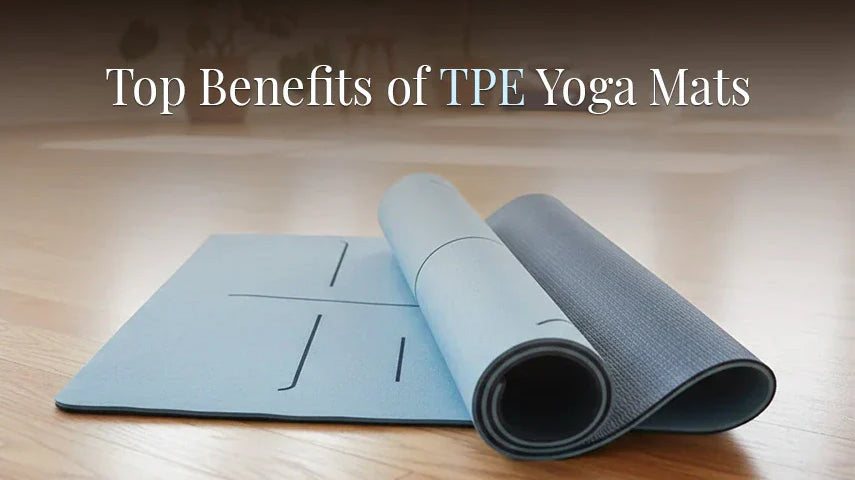
An alignment yoga mat, as the name implies, is a mat with a system of lines and markings printed directly on its surface. You can think of it as a yoga mat with a built-in instruction manual or a silent teacher. The markings are not random; they are intentionally placed to assist you to achieve better alignment in various asanas. While the markings may differ slightly depending on the brand, most designs have the following:
- A Centre Line: Aids in helping you find your balance and symmetry by making sure that you are weight-bearing equally between the left and right side of your body.
- Horizontal Lines: These lines assist you in placement of your hands and feet when in standing postures like Downward-Facing Dog Pose (Adho Mukha Svanasana).
- 45-Degree Lines: These lines will be useful when putting your back foot in an appropriate position when transitioning into standing poses like Warrior I (Virabhadrasana I) and Warrior II (Virabhadrasana II).
- Central Markers: Central Markers are often depicted as circles or logos, and they serve two purposes - they can be a focal point and sometimes serve as a reference point of where to place your hands when in Cat-Cow pose (Marjaryasana?Bitilasana).
An alignment mat was meant to give you some guidance to build good habits and muscle patterns. It will provide you with immediate visual feedback and is one of the best ways to self-correct your posture without validating any physical adjustment from your teacher, and for those who are at home practicing yoga with online videos.
Regular Yoga Mat vs Alignment Yoga Mat - Comparison Table
To make the choice clearer, let's break down the key differences between Regular Yoga Mat and Alignment Yoga Mat in a simple table.
| Feature | Regular Yoga Mat | Alignment Yoga Mat |
| Primary Purpose | To provide a non-slip, cushioned, and clean practice surface. | To guide posture and ensure proper body alignment during practice. |
| Surface Design | A blank canvas - plain, patterned, or textured, with no markings. | Features a system of lines, markers, and symbols as a guide. |
| Best For | Experienced yogis with strong body awareness, minimalists or studio-goers. | Beginners, visual learners, home practitioners or those refining their practice. |
| Learning Curve | Relies on internal sense of body position and teacher cues. | Provides immediate visual cues, helping to build muscle memory faster. |
| Dependence | Encourages you to develop an internal sense of alignment from the start. | Can potentially create a reliance on visual cues if not used mindfully. |
| Price Point | Generally, more affordable, with a very wide price range. | Typically, in the mid-to-high price range due to the added design and instructions. |
| Aesthetics | Offers a clean, minimalist, and non-distracting look. | Functional and instructional. Some may find the lines visually busy. |
Which One Should You Choose?
The "best" mat is entirely subjective and depends on your personality, your practice style, and your goals. Here's a guide to help you decide.
You should choose a regular yoga mat if:
- You have a lot of experience: You have a good awareness of your body and alignment. You know how far apart your feet need to be in Warrior II without a line to tell you.
- You mostly practice in a studio with a hands-on teacher: You are used to someone giving you verbal cues while also adjusting you physically each time you practice which is a form of personal instruction will help with your alignment.
- You prefer as little distractions as possible when you practice: You find lines or markings on a mat distracting and like to have an unobstructed space to focus inward.
- You are on a limited budget: Mats are produced regularly at various price points with standard mats generally being sold for a cheaper price if money is a key factor.
You should choose an alignment yoga mat if:
- You are a beginner: Starting a practice by using an alignment mat can be extremely helpful in developing a solid, safe foundation and avoiding common postural errors before they become habitual.
- You mainly practice at home: If you primarily participate in classes online, an alignment mat serves as a proxy for a teacher's adjustments and can help you learn where to set up your positions correctly.
- You are a visual learner: If you learn to grasp concepts best by seeing, the lines will make sense to you.
- You are working on refining your current practice: Even advanced yogis will benefit. An alignment mat can show you micro-imbalance or habits that you weren't aware of which can help you adjust in your asanas more skilfully.
- You are a yoga teacher trainee or new teacher: It can be an excellent tool for learning the geometric principles of poses, which will benefit you as you explain pose aspects to your students.
Conclusion
Ultimately, the discussion around the usage of Regular Yoga Mat vs Alignment Yoga Mat is entirely personal. Neither is right or wrong. A normal mat is a blank canvas, allowing you to develop a deep internal awareness of your body. An alignment mat gives you a map, external cues to build safe and appropriate practice. Think about where you are in your yoga experience, and what you need the most from your base. Do you need the freedom to explore, or the structure to learn? Whichever route you choose, remember, the yoga mat is a tool. The true act of yoga happens when you show up, breathe, and connect with yourself.