
Table of Contents
- Introduction
- Why Use Yoga Props for Backbending?
- Best Yoga Props for Backbending
- How to Choose the Right Yoga Props for Backbends
- Conclusion
Yoga backbending poses are a fundamental part of many yoga practices, offering a range of physical and mental benefits. These poses involve extending the spine backward, which helps to counteract the common postural issues that arise from sitting and slouching. It might make you feel strong and open your heart. But for a lot of people who do it, it may also be frustrating, scary, and even painful.
These postures, which include lengthening the spine and opening the chest, are great for improving posture, building up the back muscles, and boosting vitality. But they also need a careful balance of strength and flexibility, and if they aren't lined up correctly, they might put too much stress on the lower back. This is when yoga props come in to work their magic. Props change backbends from something that could be hard to do into something easy and enjoyable for everyone. Yoga props for backbending help by giving you support, helping you align your body, and letting you safely explore deeper.
Why Use Yoga Props for Backbending?
Backbending can be hard since it takes more than just bending your back. The legs, glutes, core, and shoulders all work together with the spine. So here are some reasons why you should use Yoga props for backbending:
- Protecting the Lower Back: "Dumping" into the lower back is a common mistake that can cause pain and compression. This happens when the core isn't working, and the curve is only in one part of the spine instead of being spread out uniformly. Using props can help you elevate and stretch your spine, which will make more room and protect this weak spot.
- Opening the Chest and Shoulders: Many of us have tense shoulders and chests from desk work or day-to-day activities. The lower back must exert all the effort because it is difficult to stretch the upper spine due to this tightness. You can perform a more balanced and efficient backbend by using props to help you gently open your shoulders and chest.
- Developing Stability and Strength: When you bend your back fully, you don't just fall back; instead, you create strength that allows you to stand up and move out of the position. Props give you a solid foundation hence if you work with them, your muscles can help you gain strength.
- Overcoming Fear: One of the main psychological obstacles to backbending is the fear of falling or injuring oneself. Because props give you stability and security, you can attempt the pose with curiosity and confidence rather than fear.
Best Yoga Props for Backbending
Including yoga props for backbending can help in improving your practice. The best backbending props and their uses are as follows:
1. Yoga Blocks:
Blocks are arguably the most versatile prop for backbending. They can provide support, help with alignment, and deepen the stretch.
How they help:
- Under the hands: By keeping blocks under your hands, you can avoid collapsing backward in poses like Bridge Pose (Setu Bandhasana) and Camel Pose (Ustrasana) by maintaining a long spine and raised chest. If you are still unable to reach your heels comfortably, this is especially helpful.
- Between the thighs: By squeezing a block between your thighs in Bridge Pose (Setu Bandhasana) or Wheel Pose (Urdhva Dhanurasana), you can strengthen your legs and shield your lower back by using your inner thighs and glutes.
- Under your shoulders/upper back: To prepare for deeper backbends, lie on a block at its lowest or medium height beneath your upper back, between your shoulder blades. This will create a lovely, passive chest opening.
2. Yoga Belts:
A yoga belt is an excellent tool for increasing mobility and getting a better grip in backbends.
How they help:
- Linking the hands and feet: In Dancer's Pose (Natarajasana), you can kick your leg back and extend your chest forward without losing your balance or straining to reach. It also helps you grasp the back foot and deepen the bend in King Pigeon Pose (Eka Pada Rajakapotasana).
- Shoulder opening: Before a backbend, open your shoulders by holding a belt behind your back with both hands. This can significantly impact how accessible poses like Wheel Pose (Urdhva Dhanurasana) are.
- Proper Alignment: In Bridge Pose (Setu Bandhasana), it helps to keep your arms parallel and maintain proper shoulder alignment. Also to avoid them splaying out and losing support, wrap a belt just above your elbows.
3. Yoga Bolsters:
Bolsters are perfect for restorative, gentle, and supported backbends, making them a fantastic prop for beginners or for winding down your practice.
How they help:
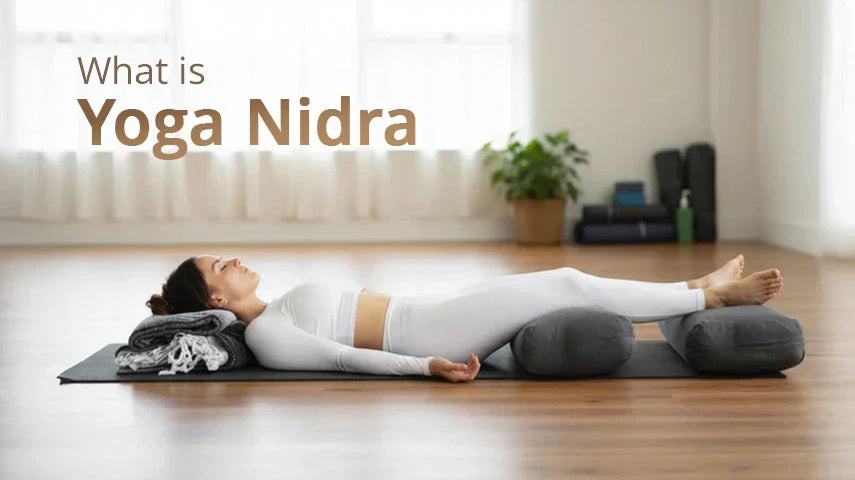
- Open the Hips and Chest: In Bridge Pose (Setu Bandhasana ) position a bolster lengthwise beneath your sacrum. This pose is a great way to let the back relax and passively open the hips and chest.
- Release Tension: In Fish Pose (Matsyasana) bolster allows you to release tension in your upper body without straining it. You do this by lying with a bolster lengthwise along your spine, from your hips to the top of your head.
- Provides Support: In Camel Pose (Ustrasana), place a bolster behind you while kneeling. This will provide a secure surface for your back to rest on as you lean back into the pose.
4. Yoga Wheel:
A more specialized prop, the yoga wheel is specifically designed to help with backbending and is a favourite among intermediate and advanced practitioners.
How it helps:
- Spinal Mobility: You can safely and effectively increase spinal mobility by rolling over the wheel, which has a circular shape that perfectly matches the natural curve of the spine.
- Opening of the Chest and Shoulders: It offers a vigorous and focused stretch for the shoulders and chest, which are frequently the areas that backbends are limited by.
- Deepening Pose: You can go deeper than you could without the wheel while maintaining stability by using it to support your back in positions like Wheel Pose (Urdhva Dhanurasana) or to enter King Pigeon Pose (Eka Pada Rajakapotasana).
5. Backbender
Backbender is specifically designed to support the practitioner in backbends and is a favourite among intermediate and advanced practitioners.
How it helps:
- Spinal Mobility: You can safely and effectively increase spinal mobility by leaning over the backbender, which has a shape that perfectly matches the natural curve of the spine.
- Opening of the Chest and Shoulders: It offers a vigorous and focused stretch for the shoulders and chest, which are frequently the areas that backbends are limited by.
- Deepening Pose: You can go deeper than you could without the backbender while maintaining stability by using it to support your back in positions like Fish Pose (Matsyasana).
How to Choose the Right Yoga Props for Backbends
Selecting the right prop is a personal journey. Here are a few factors to consider:
- Flexibility Level: Begin with bolsters and blocks if you are a beginner or if your upper back is stiff and your shoulders are extremely tight. They provide the kindest and most approachable assistance. The yoga wheel and straps may be helpful for more flexible practitioners who want to experiment with new alignment and depth.
- Experience Level: Novices should concentrate on laying a solid, secure foundation with props. This entails the use of straps for improved grip and blocks for alignment. Proficient yogis can experiment with more complex variations, target tight spots, and improve their form with props.
- Space and Yoga Style: Blocks and a strap are very portable and highly efficient if you have a small space. Don't be afraid to try new things if you are at a studio with all the props available. A bolster could be your best friend if you do yoga in a more restorative manner.
- Listening to your body: The most crucial element is paying attention to your body. Make sure the prop you choose makes you feel supported rather than strained. Instead of forcing you into a position your body is not prepared for, a prop should make the pose more accessible and comfortable.
Conclusion
Backbending is one of the most beautiful and powerful aspects of yoga. It can open not just our bodies but also our hearts and minds. Even though the journey can be challenging, you do not have to face it alone. By carefully utilizing backbending props during your practice, you can alter your backbends. Props provide the confidence, stability, and support needed to explore the exciting world of backbending with style and safety. So, the next time you unfold your mat for a backbend, remember your props; they are there to enable, not to simplify.